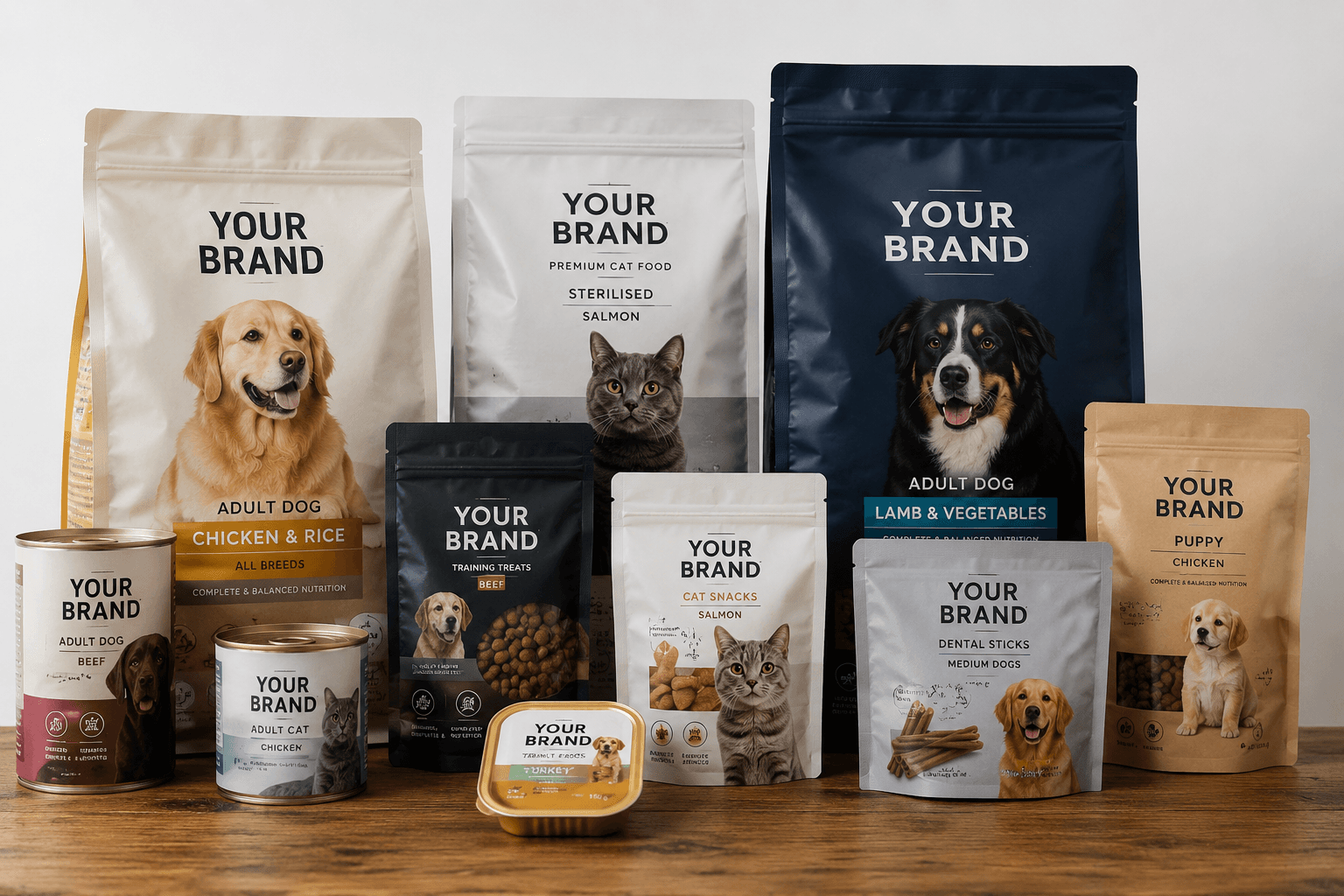
Private Label Pet Food Packaging & Labelling: What Buyers Need to Know
Packaging is where private label pet food actually becomes your brand — but it's also where regulatory compliance requirements are easiest to get wrong. This guide covers what buyers need to specify correctly, from guaranteed analysis panels to market-specific labelling rules, before finalising artwork.

What's actually on a pet food label
A compliant pet food label includes the product name, guaranteed analysis (minimum crude protein and fat, maximum fibre and moisture), ingredient list in descending order by weight, feeding guidelines, net weight, and manufacturer/distributor information. Private label buyers own the brand name and design, but the nutritional and regulatory content must match the actual formulation exactly — this isn't creative territory, it's a compliance requirement tied to the recipe your manufacturer produces. Treat the compliance-required elements as fixed inputs to the design process rather than fields to be finalised alongside the creative brand layout, since the two follow very different approval paths.
Guaranteed analysis and why it can't be guessed at
The guaranteed analysis panel is a legal claim about the product's nutrient content, and it must be substantiated by the manufacturer's actual formulation and lab testing — not estimated or copied from a similar competitor product. Buyers should request the exact guaranteed analysis figures from the manufacturer for their specific formulation before finalising label artwork, since this is one of the most commonly audited elements of pet food labelling compliance. If a manufacturer offers a minor recipe substitution during production — a different fat source due to a supply issue, for instance — the guaranteed analysis should be re-verified rather than assumed to still apply unchanged.
AAFCO and FEDIAF label requirements differ
US (AAFCO-aligned) and EU (FEDIAF-aligned) pet food labelling requirements differ in specific ways — ingredient naming conventions, required statements, and language/measurement requirements are not interchangeable between the two. A label compliant for the US market is not automatically compliant for EU markets and vice versa; buyers targeting both need separate label reviews, not a single template with translated text. See our AAFCO and FEDIAF certification guides for the underlying formulation-compliance side of this.
Nutritional adequacy statements
Pet food labels must state which life stage the formulation is appropriate for (growth, adult maintenance, all life stages) and how that claim is substantiated — formulated to meet published nutrient profiles, or validated through feeding trials. This statement must match the manufacturer's actual substantiation documentation for that specific formulation, not a generic assumption based on similar products in the category.
Have questions before you keep reading?
Get pricing, MOQs and lead times for your market.
Country-of-origin and import labelling requirements
Many markets require country-of-origin declarations and importer/distributor information on pet food packaging, in addition to the base nutritional labelling requirements. These requirements vary by destination market and are easy to overlook when a private label buyer is focused primarily on brand design — confirm import-specific labelling requirements for every target market before finalising packaging, not just the primary formulation-compliance requirements. Buyers selling into several markets from one production run should also check whether a single multi-language label satisfies every destination or whether market-specific print runs are actually required.
Packaging format and material considerations
Beyond label content, packaging format (bag structure, resealability, pouch vs. can for wet food) affects both shelf presentation and practical factors like shelf life and retailer handling requirements. Buyers should confirm barrier properties (moisture, oxygen) match the formulation's actual shelf-life needs — a private label bag that looks right but uses a lower barrier film than the formulation requires can shorten real shelf life below what the label states. Ask for the film's actual barrier specification rather than a general assurance that it's high quality.
Working with a manufacturer's packaging team vs. your own designer
Most manufacturers can produce packaging from finished artwork files, but the underlying label content (guaranteed analysis, ingredient list, regulatory statements) should be reviewed or provided directly by the manufacturer's compliance team, not assumed by an external designer unfamiliar with pet food regulatory requirements. The cleanest workflow is: manufacturer provides the compliance-required content, your designer builds the brand layout around it.
Ready to move forward?
Connect with our team to structure your order, timeline and volumes.
Common private label packaging mistakes
The most common mistake is finalising brand artwork before confirming the guaranteed analysis and regulatory statements with the manufacturer, requiring a costly reprint when the content doesn't match. The second most common mistake is assuming a single label design works across multiple target markets without a market-specific compliance review. Both are avoidable by sequencing packaging development correctly — compliance content first, brand design around it.

How Candora Petcare supports packaging and label compliance
Candora Petcare coordinates label compliance review with certified factory partners as part of every private label programme, confirming guaranteed analysis, ingredient lists, and market-specific regulatory statements match the actual formulation before artwork is finalised — reducing the risk of a costly reprint after production.
FAQ
Frequently asked questions
Yes — brand design (name, logo, layout) is yours to control, but the nutritional and regulatory content (guaranteed analysis, ingredient list) must match the manufacturer's actual formulation and be reviewed for compliance before finalising.
No. AAFCO-aligned (US) and FEDIAF-aligned (EU) labelling requirements differ in specific ways — buyers targeting both markets need separate label reviews, not a translated version of one template.
A legally required statement of minimum crude protein and fat, and maximum fibre and moisture, substantiated by the manufacturer's actual formulation and lab testing for that specific product.
Yes — barrier properties (moisture, oxygen resistance) need to match the formulation's actual shelf-life requirements; a lower-barrier film than needed can shorten real shelf life below what the label states.
The manufacturer's compliance team should provide the guaranteed analysis, ingredient list, and regulatory statements — your designer should build the brand layout around that content, not estimate it independently.
Finalising brand artwork before confirming guaranteed analysis and regulatory statements with the manufacturer, which often results in a costly reprint once the content is reviewed properly.
Ready to get started?
Contact our team to discuss volumes, pricing, and supply structures for your market.
Related