Branded & Finished Pet Food Sourcing: How It Works
Not every buyer wants to build a proprietary range. Some retailers, distributors, and importers are looking for the opposite: an existing, already-developed branded pet food line they can bring into a market or channel without owning the formulation, packaging design, or brand-building work themselves. This guide covers how that sourcing path actually works, who it fits, and how it differs from private label.

Two ways to build a pet food range
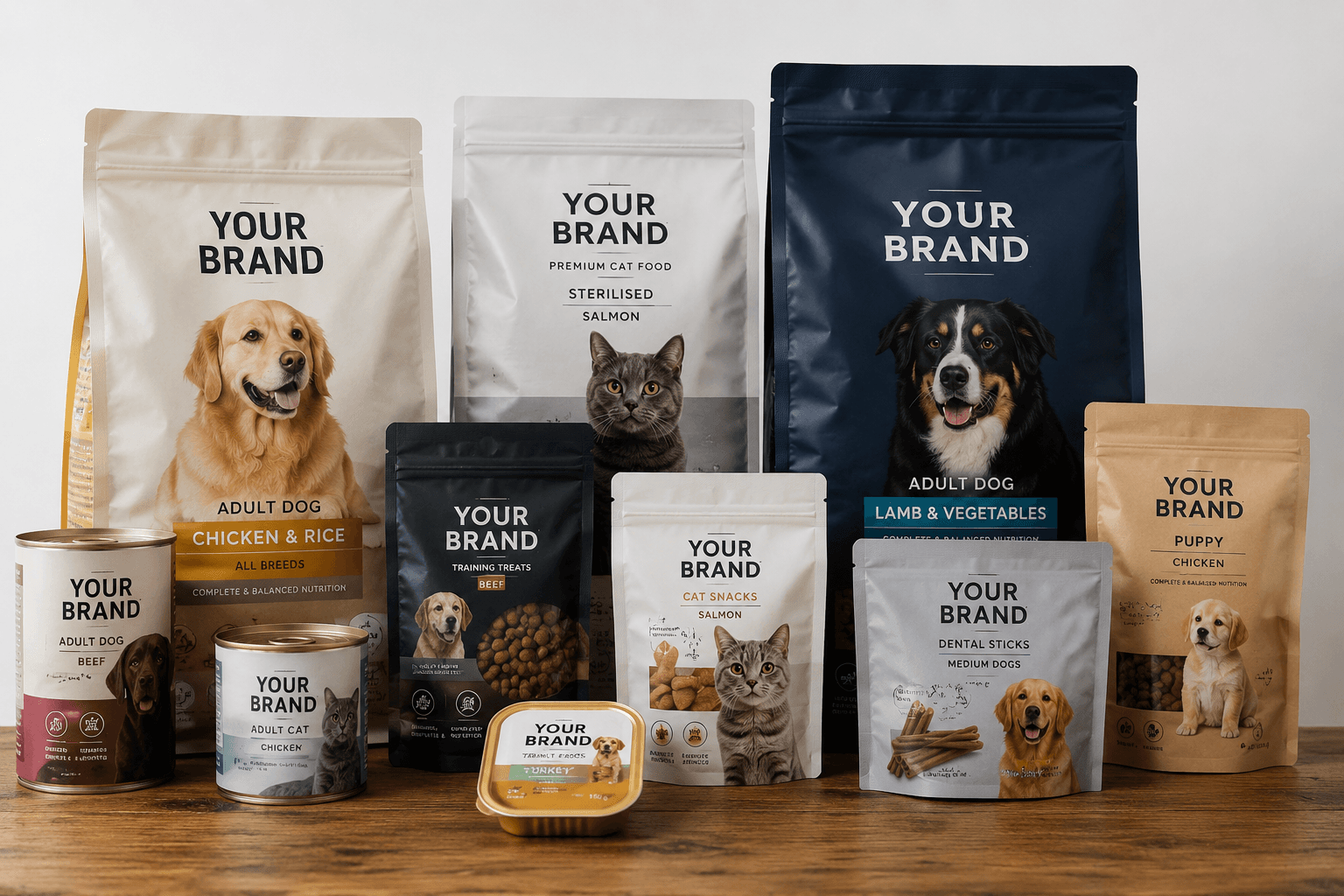
There are two fundamentally different starting points for a retailer or distributor entering pet food: build a proprietary private-label range from a manufacturer's formulation catalogue, or bring in a product that already exists as a finished, branded line and focus on distribution rather than product development. Most buyer content — including most of Candora Petcare's own library — has historically focused on the first path. This guide addresses the second, because it's a genuinely distinct decision with its own economics and timeline, not a lesser version of private label.
What finished-goods sourcing actually means
Finished-goods sourcing means the product's recipe, packaging, and brand identity are already set before you get involved — your role is securing supply and the right to distribute it into a market, channel, or region, not shaping what the product is. That's the core distinction from private label, where you're commissioning a manufacturer to produce something under your own brand from their base formulations. With finished goods, the formulation and branding decisions have already been made by whoever developed the line; your negotiation is about supply terms, territory, and volume, not product design.
Who this path fits best
Finished-goods sourcing tends to fit buyers who want to test a category or market before committing capital to their own brand, distributors whose core competency is logistics and retail relationships rather than product development, and retailers who want a differentiated branded item on shelf without the lead time a private-label launch requires. It also fits buyers expanding into a new geography where an established product already has demonstrated demand elsewhere, and the buyer's job is getting it compliant and available locally rather than proving the concept from zero.
Have questions before you keep reading?
Get pricing, MOQs and lead times for your market.
How distribution rights and territory work
Bringing in a finished branded product means agreeing on what rights you're actually getting: which territory or channel you can sell into, whether that right is exclusive or shared with other distributors, and for how long. These terms vary by arrangement and are negotiated case by case rather than following a fixed template — a buyer should go in with a clear view of the territory and channel they actually need covered, since that scope is usually the single biggest lever in the negotiation, more than unit price.
Lead time and minimum order considerations
Because the formulation and production line already exist, finished-goods sourcing generally removes the lead time a new private-label formulation requires for recipe development, trial runs, and packaging design — the product is already in production. Minimum order quantities are still shaped by the manufacturer's existing production batch economics, the same underlying driver as private-label MOQs, but buyers aren't also absorbing a new formulation's setup costs on top of that. The practical result is usually a faster path from agreement to shelf than a from-scratch private-label launch, though actual timelines depend on the specific product and production schedule.
Import compliance and market-entry labeling
An existing branded product built for one market doesn't automatically clear compliance in another. Ingredient lists, nutritional adequacy statements, and labeling requirements differ between frameworks like AAFCO in the US and FEDIAF across the EU, and a product formulated to satisfy one may need label changes, additional testing, or formulation review before it can be sold under the other. Buyers importing a finished branded line into a new market should treat this as a defined step in the process, not an afterthought — see our AAFCO and FEDIAF certification guides for what each framework actually requires.
Ready to move forward?
Connect with our team to structure your order, timeline and volumes.
Where this differs from private label — and where it doesn't
Both paths run through the same kind of formal, structured supply relationship rather than ad-hoc spot buying — that part doesn't change. What changes is where you sit in the value chain: private label gives you control over branding and margin structure in exchange for owning the formulation and go-to-market work; finished-goods distribution gives you speed and an already-proven product in exchange for less control over recipe, packaging, and long-term brand economics. Neither is categorically better — the right choice depends on whether your business's strength is product development and brand-building or logistics, retail relationships, and market access.

How Candora Petcare approaches finished-goods sourcing
Candora Petcare sources based on what the buyer actually needs — the same need-based model Candora Trading already runs under the same legal entity — rather than being a private-label-only shop. That means a conversation about finished-goods sourcing starts with your category, target market, and channel, and moves toward matching that need through our supply network. We don't publish a static catalogue of available branded lines here, since what's available shifts with our network and your specific requirements; the next step is a direct conversation about what you're trying to bring to market.
FAQ
Frequently asked questions
It means sourcing an already-developed, already-branded pet food product for import and distribution, rather than commissioning your own private-label formulation. The recipe, packaging, and brand identity already exist; your role is securing supply and distribution rights.
Generally yes, because the formulation, recipe testing, and packaging design work is already done. The remaining steps are supply-agreement negotiation and, if entering a new market, compliance and labeling review — both faster than a from-scratch private-label development cycle.
That depends on the specific agreement — exclusivity by territory or channel is negotiable but not automatic or universal. Buyers should define the territory and channel scope they need before entering discussions, since that scope is typically the central negotiating point.
Not automatically. Ingredient lists, nutritional adequacy claims, and labeling rules differ between frameworks like AAFCO (US) and FEDIAF (EU), so a product built for one market often needs label changes or formulation review before it can be sold compliantly in another.
Private label means commissioning a manufacturer to produce a formulation under your own brand — you control branding but take on formulation and go-to-market work. Finished-goods sourcing means distributing a product whose formulation and branding already exist — faster to market, but with less control over the recipe and long-term brand economics.
MOQs are shaped by the manufacturer's existing production batch economics, similar to the underlying driver behind private-label MOQs — but buyers aren't also absorbing new-formulation setup costs, since the product is already in production.
No — availability shifts with our supply network and each buyer's specific category, market, and channel needs, so we don't maintain a static public catalogue. The next step is a direct conversation about what you're trying to bring to market.
Ready to get started?
Contact our team to discuss volumes, pricing, and supply structures for your market.