Private Label vs. OEM vs. Contract Manufacturing: Choosing a Pet Food Sourcing Model
Buyers often use 'private label,' 'OEM,' and 'contract manufacturing' interchangeably, but they describe genuinely different sourcing relationships with different cost structures, MOQ commitments, and levels of control over the finished formula. Picking the wrong one for your stage of business is a common, expensive mistake. This guide breaks down the real tradeoffs between all three.

Three models, one spectrum
Private label, OEM, and contract manufacturing aren't three unrelated options — they sit on a single spectrum running from lowest control and lowest commitment (private label) to highest control and highest commitment (contract manufacturing). Understanding where each sits relative to the others makes the actual decision much easier: it isn't 'which is best,' it's 'how much control does my brand strategy actually require, and can my volume support the commitment that control demands.' Buyers who skip this framing tend to over-commit to custom manufacturing before they have the order volume to make it economical, or under-commit to catalogue private label when their brand positioning genuinely needs a differentiated formula.
Private label: the fastest path to market
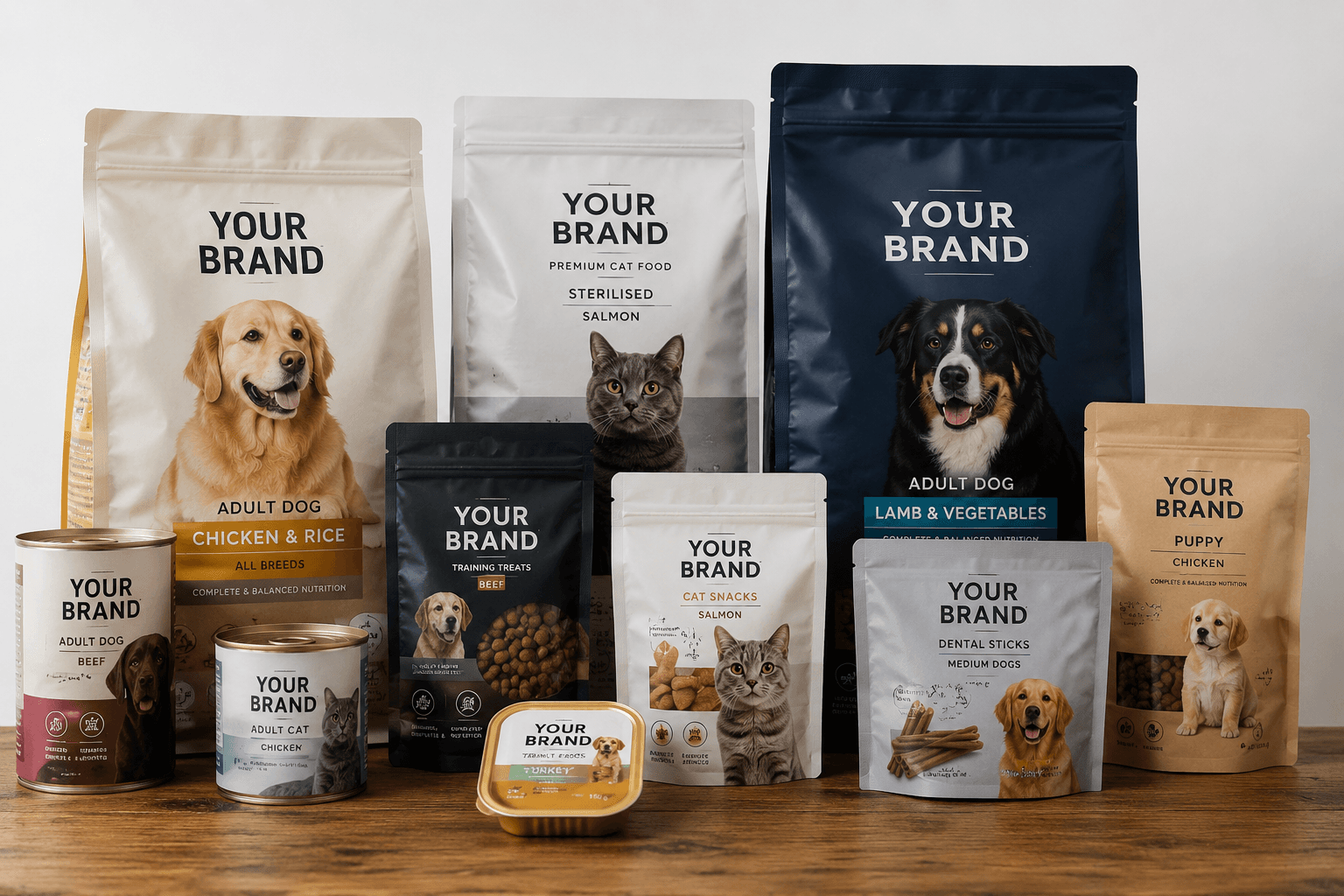
Private label means choosing from a manufacturer's existing catalogue of pre-formulated recipes and applying your own branding, packaging, and pricing on top. The manufacturer has already done the formulation, sourcing, and compliance work — your job is branding and go-to-market. This is the lowest-MOQ, lowest-upfront-cost, fastest-to-shelf option of the three, which makes it the standard starting point for a new brand testing demand before committing capital to a differentiated recipe. The tradeoff is real: your formula isn't unique, and a competitor could theoretically source the identical base recipe from the same manufacturer under different branding.
OEM manufacturing: the middle ground
Under an OEM (Original Equipment Manufacturer) arrangement, the manufacturer produces to something closer to your specification, but typically retains ownership of the underlying manufacturing-process IP and gives the brand owner limited direct input into specific ingredient sourcing decisions. It sits between fully catalogue-based private label and a ground-up custom recipe: more brand-specific than private label, but without the full formulation control (or full cost commitment) of contract manufacturing. Buyers moving past initial market-testing but not yet ready for a fully bespoke recipe often land here.
Contract manufacturing: full custom control
Full contract manufacturing means a formula developed specifically for your brand, from ingredient selection through to final specification — genuinely differentiated, and typically with clearer buyer ownership of the recipe itself, though this needs to be explicit in the contract rather than assumed. It also carries the highest upfront investment of the three models, particularly when the formula calls for unique raw materials that themselves carry their own MOQ requirements, which compounds on top of the production MOQ. This is the right model once a brand has proven demand and needs genuine formulation differentiation to compete, not before.
Have questions before you keep reading?
Get pricing, MOQs and lead times for your market.
MOQ and cost tradeoffs in real numbers
MOQs vary sharply by format as well as by model. Dry extruded kibble production runs commonly sit in the 20,000-40,000 lb range per batch, driven by extrusion-line die-change economics. Wet/canned typically needs 1-2 full truckloads (roughly 40,000-80,000 cans) because of retort sterilisation and canning-line setup costs. Freeze-dried and raw formats can start lower, around 5,000-10,000 lbs, since freeze-drying and HPP processing run as dedicated batch cycles rather than continuous lines — but the per-pound cost is materially higher, so a lower MOQ doesn't automatically mean a lower total commitment. Fixed-formula contract agreements generally carry higher MOQs and less ingredient-pricing flexibility than catalogue-based private label, regardless of format.
Lead time differences across the three models
Private label is fastest to shelf since the formulation, safety testing, and regulatory groundwork are already done — buyers are mainly waiting on packaging production and a standard manufacturing run. OEM adds time for spec alignment and any ingredient-sourcing negotiation specific to the arrangement. Contract manufacturing adds the most lead time of the three, since a genuinely new formula needs recipe development, palatability and safety validation, and often a pilot batch before committing to full production — buyers should budget meaningfully more calendar time for a first contract-manufactured launch than for a private label one.
Compliance and label-claim burden
Under private label, the base formula's AAFCO or FEDIAF nutrient-adequacy substantiation is typically already established by the manufacturer for that recipe — buyers still need to verify it applies to their specific target market and life-stage claim, but they aren't starting from zero. Under contract manufacturing, a genuinely new formula means the substantiation work (and the decision of formulation-based versus feeding-trial validation, where relevant) starts fresh, and the buyer carries more direct responsibility for confirming it's been done correctly before any life-stage or 'complete and balanced' claim goes on packaging.
Ready to move forward?
Connect with our team to structure your order, timeline and volumes.
The IP question buyers forget to ask
Formula and manufacturing-process IP ownership is the single most commonly overlooked question across all three models. Under OEM, the manufacturer typically retains process IP by default. Under contract manufacturing, recipe ownership is genuinely negotiable and should be written into the contract explicitly — not assumed — since it directly determines whether a brand can take its formula to a different manufacturer later if the relationship ends. Buyers should raise this question before signing, not after a dispute makes it urgent.
Which model actually fits your stage
Private label fits new brands validating demand on limited budget, or established brands extending into an adjacent category without a large capital commitment. OEM fits brands with some proven traction that want more brand-specific input without the cost and lead time of a fully custom recipe. Contract manufacturing fits brands with validated demand, a genuine formulation-differentiation strategy, and volume that can absorb the higher MOQ and upfront cost. Matching the model to your actual stage — not your ambition — is the practical decision that avoids overcommitting capital too early or underdelivering on brand differentiation too late.
How Candora Petcare supports this decision
Candora Petcare works through this exact framework with buyers directly — mapping current stage, budget, and differentiation needs against private label, OEM, and contract manufacturing options, and connecting buyers with manufacturers whose format capabilities and MOQ structures genuinely fit the chosen model, rather than defaulting every buyer to the same sourcing path.
FAQ
Frequently asked questions
Private label means choosing from a manufacturer's existing pre-formulated catalogue and applying your own branding. OEM gives the brand owner more spec-level input, but the manufacturer typically still retains ownership of the underlying manufacturing-process IP and the buyer has limited input into specific ingredient sourcing.
Generally yes — fixed-formula contract agreements typically carry higher MOQs and less ingredient-pricing flexibility than catalogue-based private label, and custom raw materials often carry their own separate MOQ that compounds the total commitment.
It varies and should never be assumed. Under OEM, the manufacturer typically retains process IP by default. Under contract manufacturing, recipe ownership is genuinely negotiable — get it written into the contract explicitly before signing.
Private label, since the formulation, safety testing, and regulatory groundwork already exist. Contract manufacturing takes meaningfully longer because a genuinely new formula needs development and validation before a full production run.
Not inherently — private label recipes come from the same manufacturers' production capability, just without brand-specific customization. Quality depends on the manufacturer's actual production standards, not which of the three models a buyer chose.
Yes. Private label formulas typically already have nutrient-adequacy substantiation in place for that recipe; a new contract-manufactured formula needs that substantiation built fresh, and the buyer carries more direct responsibility for confirming it's correct.
Yes, and it's a common growth path — start with private label to validate demand on lower capital commitment, then move to contract manufacturing once volume and brand differentiation strategy justify the higher MOQ and upfront investment.
Ready to get started?
Contact our team to discuss volumes, pricing, and supply structures for your market.