Private Label Pet Food for the Canadian Market
Canada's split grocery/mass-retail and pet-specialty channel structure, combined with mandatory bilingual packaging and provincial sales tax that applies at full rate, makes a Canadian private label launch a genuinely distinct planning exercise from an EU or US programme. This guide covers what a private label buyer specifically needs to know about Canada.

Why Canada is a distinct private label planning exercise
A Canadian private label pet food launch needs to account for mandatory bilingual packaging, full provincial sales tax exposure with no grocery-style exemption, and a genuinely different regulatory framework (AAFCO-voluntary, CFIA-import-focused) than either an EU FEDIAF market or a US AAFCO-enforced state framework. See our general private label manufacturer guide for the underlying private label mechanics that apply regardless of destination market, then layer Canada-specific requirements on top before finalising a launch plan.
Canadian retail channels for private label pet food
Private label pet food in Canada moves primarily through grocery and mass-market retail, where private label penetration is well established and carries roughly half of category sales by value, alongside a smaller but real presence in pet specialty retail. Confirm with your target retail partner which channel positioning (value, mid-market, premium) fits your planned formulation and packaging before finalising either, since grocery private label programmes typically favour a leaner packaging approach than specialty pet retail expects. E-commerce is a third viable channel for a private label launch, particularly for a brand without an existing grocery or specialty retail relationship to lean on at the outset.
Bilingual packaging for a private label launch
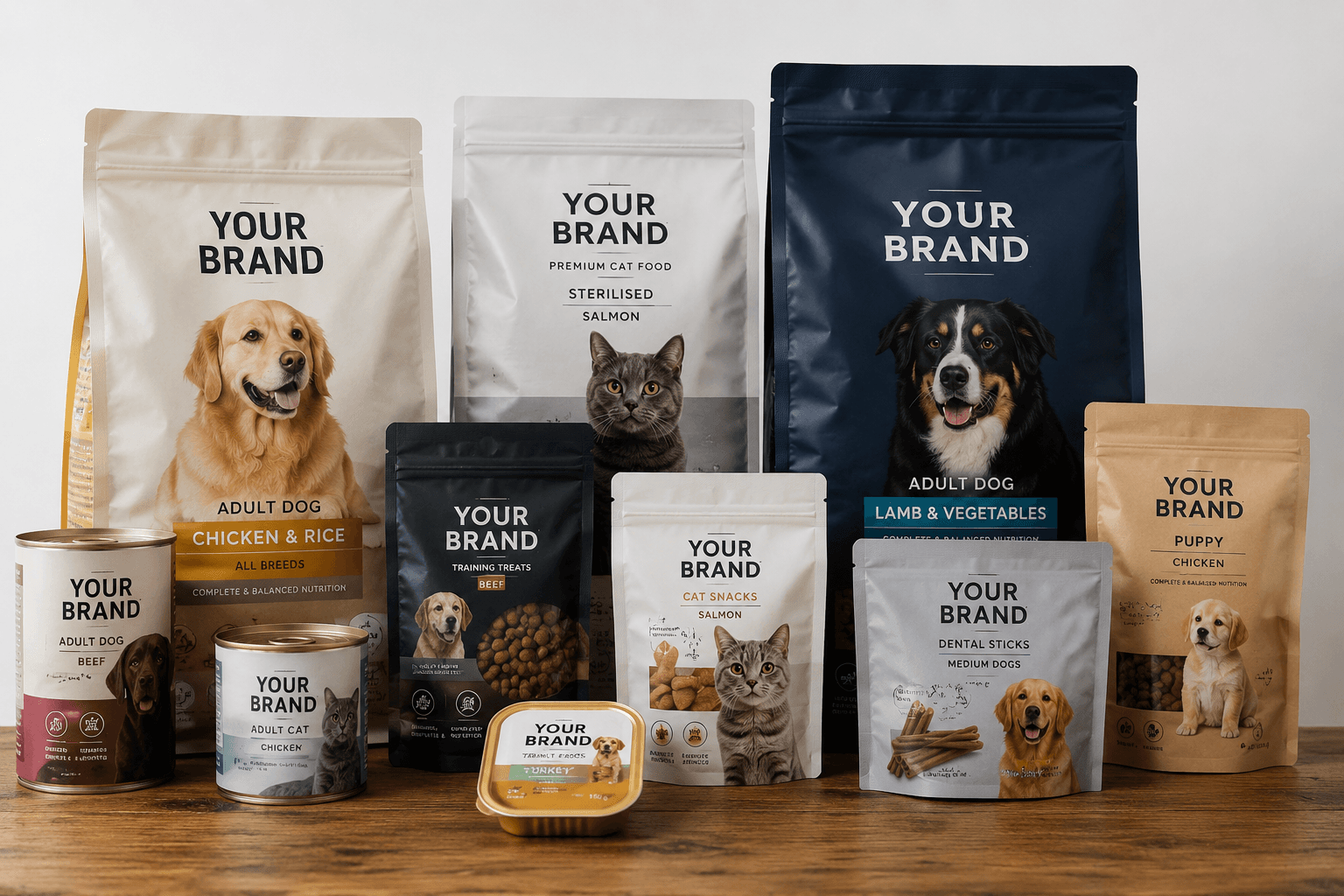
A Canadian private label range needs full English and French statutory label content from the outset — product identity, net quantity, and required statements — with only the manufacturer's name and address permitted in one language. See our private label packaging and labelling guide for how compliance content should be sequenced ahead of finalising brand artwork, and confirm Quebec-bound product meets the province's additional French-prominence requirements separately from the federal bilingual baseline.
GST/HST/PST margin modelling for private label pricing
Private label pet food in Canada carries the same full provincial tax exposure as any branded product — no reduced or zero rate applies anywhere in the country. Build the actual applicable provincial rate into margin models per target province rather than a single blended national assumption, since the gap between a 5%-GST-only province and 15% HST in Atlantic Canada or roughly 14.975% combined GST+QST in Quebec is meaningful enough to shift private label pricing strategy province by province.
Have questions before you keep reading?
Get pricing, MOQs and lead times for your market.
AAFCO substantiation for a private label formulation
A Canadian private label formulation commonly follows AAFCO's nutrient profiles voluntarily to support a 'complete and balanced' claim, even though nothing in Canadian law requires it. Confirm the manufacturer's substantiation documentation is specific to your exact private label formulation and life stage, not a general company-wide AAFCO reference, since a mismatched claim on your own private label packaging carries direct Competition Act exposure for your brand specifically.
MOQ considerations for a Canadian private label launch
Standard private label MOQ guidance applies to Canada the same way it does to any market — see our private label MOQ guide for format-specific ranges — though buyers targeting a specific Canadian retail channel may find manufacturers with existing Canadian bilingual-packaging production experience offer more flexible first-order minimums given established production familiarity. Raise this directly in early sourcing conversations rather than assuming the standard quoted MOQ is the manufacturer's only option.
CUSMA and cross-border private label sourcing
Many Canadian private label brands source formulation and production from US-based or US-adjacent manufacturers, leveraging CUSMA's duty-free treatment for compliant goods and the two countries' closely integrated pet food supply chains. Given how volatile US-Canada trade relations have been through 2025-2026, buyers building a cross-border private label supply chain should confirm current tariff and rules-of-origin status specifically for their formulation before committing to a manufacturer relationship, rather than assuming general CUSMA membership settles the question.
Ready to move forward?
Connect with our team to structure your order, timeline and volumes.
Working with a Canada-experienced private label manufacturer
Ask a prospective manufacturer specifically about existing Canadian retail relationships and bilingual label production experience — this combination reduces both compliance risk and time-to-shelf for a first Canadian private label launch. A manufacturer that can name specific Canadian retail channels they've already supplied, and describe how they handle Quebec-specific labelling separately from the rest of the country, is a stronger signal than general North American experience alone. Ask for a recent, concrete example rather than a general assurance of bilingual capability.
Timeline expectations for a Canadian private label launch
A Canadian private label launch generally follows the same 6-10 week formulation-to-production timeline as any private label programme elsewhere, though buyers should add time for bilingual label review and Quebec-specific compliance verification if this isn't already built into the manufacturer's standard process from the outset. Build this buffer into any retail launch date commitment rather than promising a date based on formulation timeline alone. A first Canadian order is also a reasonable point to confirm actual CFIA import processing time against the manufacturer's quoted estimate, since that step is easy to underestimate on a first shipment.

How Candora Petcare supports private label launches in Canada
Candora Petcare coordinates AAFCO-aligned formulation selection, bilingual English/French label compliance, and Canadian retail channel context for buyers building a private label pet food range for the Canadian market, from initial formulation selection through to first shipment, including Quebec-specific labelling review where that applies to the target retail footprint.
FAQ
Frequently asked questions
No — it carries exactly the same full provincial GST/HST/PST exposure as any branded pet food, with no reduced or zero rate available anywhere in the country.
Yes — full English and French statutory label content is required, with only the manufacturer's name and address permitted in one language, plus additional French-prominence rules for Quebec-bound product.
Grocery and mass-market retail carries the largest share of private label pet food by value, with a smaller but real presence in pet specialty retail — confirm channel positioning before finalising formulation.
Not legally, but most private label ranges follow AAFCO's nutrient profiles voluntarily to support a 'complete and balanced' claim — confirm the substantiation is specific to your exact formulation.
Often yes, and many Canadian private label brands do given CUSMA's duty-free treatment for compliant goods — but verify current tariff and rules-of-origin status for your specific product given 2025-2026 trade volatility.
Generally the same 6-10 week formulation-to-production timeline as elsewhere, plus additional time for bilingual label review and Quebec-specific compliance verification if not already part of the manufacturer's standard process.
Ready to get started?
Contact our team to discuss volumes, pricing, and supply structures for your market.