Private Label vs. Branded Finished Product Sourcing: Which Fits Your Business
Buyers evaluating a new pet food range often assume the choice is which manufacturer to use, when the more consequential decision comes earlier: whether to build a private-label range at all, or source an already-developed branded product instead. Both are legitimate, structured sourcing paths — this guide compares them directly on the factors that actually drive the decision.

The real decision comes before the manufacturer search
It's common for a buyer to start by comparing manufacturers, when the decision that actually shapes cost, timeline, and long-term economics is upstream of that: are you building a proprietary range (private label) or distributing an existing one (finished goods)? Getting this decision right first makes every downstream conversation — MOQs, pricing, timeline — much clearer, because the two paths have genuinely different cost and control structures.
Speed to market
Private label requires formulation selection or development, packaging design, label compliance review, and often a production trial run before your first commercial batch ships — a process that takes real time even when using a manufacturer's existing base recipes. Finished-goods sourcing skips most of that: the product already exists and is already in production, so the remaining work is supply-agreement negotiation and, for a new market, compliance/labeling review. For a buyer prioritizing speed, finished goods is generally the faster path.
Brand control and differentiation
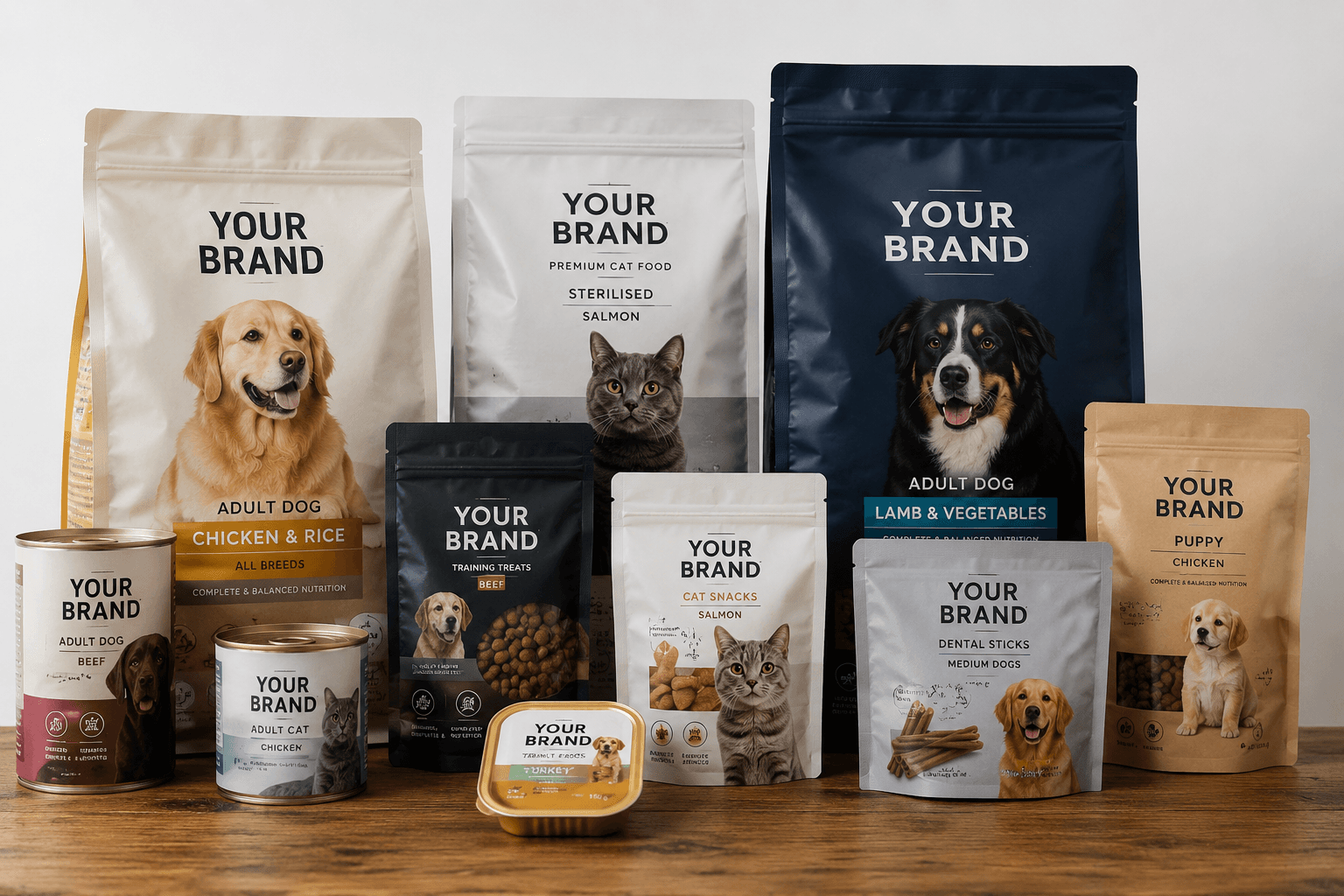
Private label gives you your own brand identity, packaging design, and positioning — genuine differentiation from competitors stocking the same manufacturer's catalogue under different labels only if your branding and marketing actually build distinct equity. Finished-goods distribution means you're selling someone else's brand; your differentiation comes from being the buyer's chosen route to market in your territory, not from the product itself. Buyers building long-term brand equity generally lean private label; buyers prioritizing category presence and speed lean finished goods.
Cost structure
Private label carries upfront costs tied to formulation/recipe work, packaging design, and compliance testing before any product ships, on top of per-unit manufacturing cost. Finished-goods sourcing generally removes most of that upfront product-development cost — you're negotiating supply terms and per-unit pricing for a product that already exists — though territory or exclusivity terms can affect the commercial terms you're offered. Neither path is categorically cheaper; the cost sits in different places.
Have questions before you keep reading?
Get pricing, MOQs and lead times for your market.
Minimum order quantities
Both paths have MOQs shaped by the manufacturer's production batch economics — extrusion, canning, or freeze-drying runs all have practical minimum batch sizes regardless of who owns the brand on the package. The difference is that private-label MOQs sometimes also reflect a new formulation's setup costs, while finished-goods MOQs are purely a function of the existing production line's standard batch size, which can make finished goods somewhat more flexible for a buyer testing a smaller initial order.
Long-term margin and equity
Private label builds an asset: over time, a well-positioned private-label range becomes a proprietary piece of your business that competitors can't simply replicate by contacting the same manufacturer for the same finished product. Finished-goods distribution doesn't build that same long-term brand equity — your margin and market position depend on maintaining favorable distribution terms rather than owning a brand asset. Buyers should weigh this against how central owning a proprietary pet food range is to their broader business strategy.
Risk profile
Private label carries more upfront execution risk — a formulation or packaging misstep is your business's cost to fix. Finished-goods distribution carries different risk: dependence on a supply relationship and distribution terms you don't fully control, and exposure if that relationship changes. Neither risk profile is inherently worse; they're different risks that suit different organizational strengths — product development capability versus logistics and channel-relationship strength.
Ready to move forward?
Connect with our team to structure your order, timeline and volumes.
How to decide
A useful starting question: is your organization's core strength product development and brand-building, or logistics, retail relationships, and market access? Buyers strong in the former tend to get more long-term value from private label. Buyers strong in the latter — including distributors and retailers whose job is moving product through channels, not designing it — often get to market faster and with less execution risk through finished-goods sourcing. Many buyers ultimately run both paths across different parts of their portfolio, need-based, rather than committing exclusively to one.

Combining both models in a single portfolio
In practice, many established retailers and distributors don't pick one model exclusively — they run a portfolio that blends both. A common pattern: use finished-goods distribution to enter a new category or test a new market quickly, gather real sales data and retail feedback, and then decide category by category whether it's worth developing a private-label equivalent once demand is proven. Core, high-volume categories where long-term margin and brand equity matter most are more likely to graduate to private label over time; smaller or more experimental categories often stay on the finished-goods path indefinitely because the volume never justifies the private-label development investment. Revisiting this allocation periodically, rather than treating the initial choice as permanent, is generally how buyers get the most value from having both paths available.
FAQ
Frequently asked questions
Neither is categorically cheaper — private label carries upfront formulation, packaging, and compliance costs before any product ships; finished-goods sourcing avoids most of that but the ongoing economics depend on the specific supply and distribution terms negotiated.
Finished-goods sourcing is generally faster, since the formulation, recipe development, and packaging design are already complete. Private label requires that work up front, which adds real time even when starting from a manufacturer's existing base recipes.
Yes — many buyers use finished-goods distribution to test demand in a category or market, then move to a private-label range once demand is proven and they're ready to invest in a proprietary formulation and brand.
Both are shaped by the manufacturer's production batch economics, but private-label MOQs can also reflect new-formulation setup costs. Finished-goods MOQs are purely a function of the existing production line's standard batch size, which can make them somewhat more flexible for smaller initial orders.
Not automatically. Private label creates the potential for long-term brand equity and margin control, but that value depends on successful branding and marketing execution — it isn't guaranteed simply by owning the label.
Yes — sourcing is based on what you actually need, which can mean private label for one category and finished-goods distribution for another within the same buyer relationship.
Ready to get started?
Contact our team to discuss volumes, pricing, and supply structures for your market.